
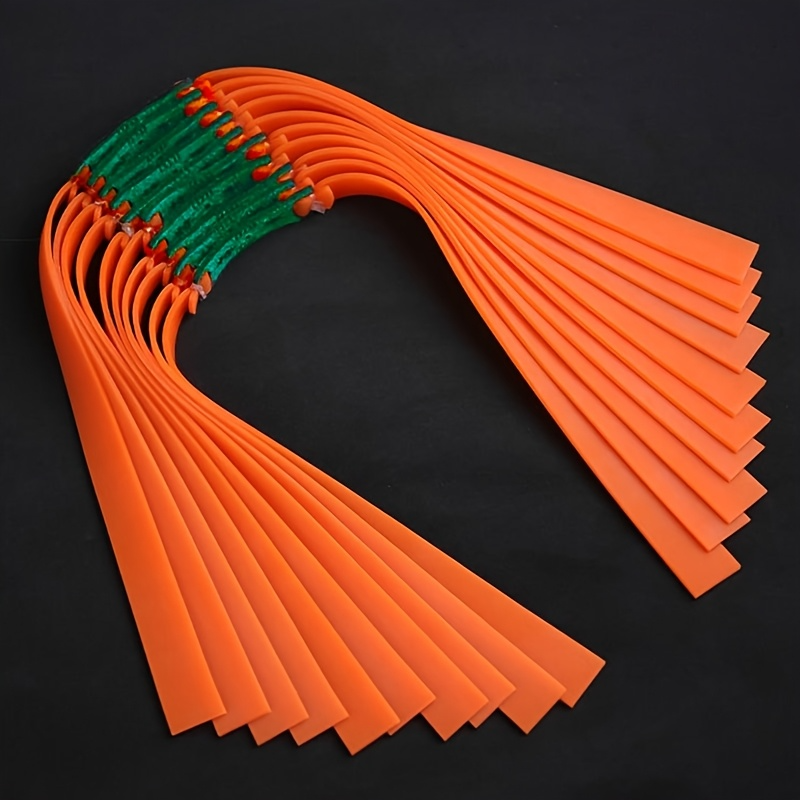
When choosing slingshot rubber bands, the following points can be considered:
• Power and adaptability: Select rubber bands that suit your strength, ensure that you can fully stretch them and match them with the beads used.
• Type of rubber bands: Flat rubber bands have a higher initial velocity and better stability, while round rubber bands have a lower initial velocity and poorer stability.
• Length selection: The length of the rubber bands has a great impact on the performance of the slingshot. Usually, a length of 20 - 30 centimeters is more appropriate, but the specific length should be adjusted according to the slingshot model and personal habits.
• Seasonal factors: Choose anti - freeze rubber bands in cold regions to extend their service life; there is no special need for selection in summer.
By considering the above points, it can help you better choose suitable slingshot rubber bands.
Shortly after novice slingshot enthusiasts start their journey, a common question they often ask is: What configuration of rubber bands should I choose?
This seemingly simple question, when truly delved into for a clear explanation, involves quite a few factors and trade - offs. I was confused about it for a long time, anyway.
I'll offer a train of thought based on my experience as a beginner for reference.
The kinetic energy of the marble comes from the work done by the potential energy of the rubber band. According to the work - done principle, the determining factors are the maximum pulling force and the work - done distance, and the calculation method can be approximated by the area of a triangle.
Work done by rubber band = Kinetic energy of marble + Kinetic energy of rubber band and pouch ≈ (Maximum pulling force × Work - done distance) / 2
Work - done distance of rubber band = Draw length - Rubber band tying length
The above are the basic principles.
Selection sequence:
1. Determine the draw length:
First, based on the posture you like, determine your draw length. Each draw length has its own advantages and disadvantages, and there is no absolute good or bad. Whether you like the precision of short - draw, the balance of medium - draw, or the posture of long - draw, it's all fine. The key to playing with a slingshot is to have fun, and what you like and are willing to do is the most important. Determine your posture early because the aiming points are different for different postures. For example, I like medium - draw, and my draw length is 110 cm.
2. Determine the maximum pulling force:
In the posture you like, use a rope and an electronic hook scale. Pull one end with each hand and measure your maximum strength in this posture (the maximum strength can increase with exercise). Then, use about 3/4 of your maximum strength as the maximum pulling force of your rubber band, that is, the pulling force of the rubber band when it is drawn to your draw - length position. This is not necessarily the ultimate tensile strength of the rubber band. Choosing 3/4 is my personal opinion. If it's too small, you're wasting your strength; if it's too large, it's not easy to maintain stability when aiming. For example, when my draw length is 110 cm, my maximum strength is 6 kg. Taking 3/4, the maximum pulling force is 4.5 kg.
3. Next, choose the rubber band:
Principle: Maximize the output kinetic energy and prolong the rubber - band lifespan as much as possible.
To achieve a maximum pulling force of 4.5 kg, there are multiple solutions. For example, for a certain brand of rubber bands (the data are all made - up by me, just to get the point across):
0.4 mm, 20 mm width, 6 - times draw ratio, pulling force 4.5 kg
0.5 mm, 20 mm width, 5 - times draw ratio, pulling force 4.5 kg
0.6 mm, 20 mm width, 4 - times draw ratio, pulling force 4.5 kg
0.75 mm, 20 mm width, 3 - times draw ratio, pulling force 4.5 kg
All of them can achieve a pulling force of 4.5 kg. But calculate their tying lengths and work - done distances:
For 0.4 mm: Tying length: 110 / 6 = 18.3 cm, Work - done distance: 110 - 18.3 = 91.7 cm
For 0.5 mm: Tying length: 110 / 5 = 22 cm, Work - done distance: 110 - 22 = 88 cm
For 0.6 mm: Tying length: 110 / 4 = 27.5 cm, Work - done distance: 110 - 27.5 = 82.5 cm
For 0.7 mm: Tying length: 110 / 3 = 36.7 cm, Work - done distance: 110 - 36.7 = 73.3 cm
With the same maximum pulling force, the work done by the rubber band is determined by the work - done distance. That is to say, the 0.4 - mm rubber band does the most work.
Not only that, in this rubber - band work - done system, it not only accelerates the marble but also itself. Simply put, the lighter the rubber - band's self - weight, the higher the proportion of the output energy used to accelerate the marble. So in the example above, the 0.4 - mm rubber band not only has a higher total energy in the entire rubber - band work - done system due to its high stretch ratio and long work - done distance but also has a higher proportion of output energy because it is thinner, shorter, and lighter in self - weight.
There is also the taper, which is used to improve the energy - output ratio.
In simple terms, under the same draw length and pulling - force specifications, the implementation plan with a high stretch ratio and a large taper can obtain a higher system output kinetic energy. As for whether you choose a large marble with a low initial velocity or a small marble with a high initial velocity for this higher output kinetic energy, it depends on your preference.
The only possible drawback of this plan is that it may be costly. Rubber bands with an extremely high stretch ratio and an extremely large taper are prone to breaking. Of course, if you don't even mind changing a rubber band every 20 shots, then forget what I said. After all, the key to playing with a slingshot is to have fun. So, ultimately, you need to make a trade - off and balance between output kinetic energy and rubber - band lifespan.