Unlock a New Way to Play with Slingshots: The 30-Meter Precision Shooting Challenge: A Step-by-Step Guide from Rookie to Expert
For slingshot enthusiasts, the joy of shooting lies not only in the moment of a precise hit, but also in the constant challenge of pushing boundaries. If you're tired of repetitive practice at a fixed range, try the "30-Meter Precision Shooting Challenge"—a fun and challenging challenge that's quietly gaining popularity in the slingshot community. Today, we'll break down the challenge's gameplay design, training techniques, and fun extensions, allowing you to create your own shooting range at home and easily unlock new slingshot skills.
一、Challenge Design: A Step-by-Step Approach from "Hit" to "Accurate"
The core of the 30-Meter Precision Shooting Challenge is its "gradual progression" approach. This prevents beginners from being put off by the initial difficulty, while also giving veterans the motivation to keep pushing the boundaries. You can set targets according to the following steps:
Beginner: Shoot at a "large target" at 30 meters, practicing "hitting it" first.
Beginners are recommended to start with targets with a diameter of 30 cm or more, such as:
Creative targets: Circular targets made of colored KT board (draw cartoon patterns on them for added fun), hanging inflated balloons (the sound of them popping after a hit is incredibly relaxing), plastic bottles filled with sand (the weight is stable and prevents them from flying).
Success criteria: At least 6 out of 10 shots hit the target. Focus on training the basic skills of "steady gun control and trajectory prediction." Don't worry about accuracy at this stage; just land your bullet within the target area.
Advanced: Smaller Targets, Challenge "Accuracy"
Once you can consistently hit a 30cm target, you can reduce the target to 15-20cm and try these advanced gameplay methods:
Dynamic Target Challenge: Hang a can with fishing line and gently shake it to simulate a "moving target" to practice trajectory prediction. Alternatively, draw concentric circles on the target, marking areas with scores of 10-50, and calculate the total score after 10 rounds. This instantly increases your competitiveness.
Scenario-Based Shooting Range: Incorporate outdoor settings, such as taping target paper to tree trunks (simulating a wild hunting scene) or placing "obstacle targets" in open areas (using cardboard boxes to partially block the target surface to practice finding gaps in aiming).
Expert Level: Extreme Challenges, Unlock the "Sharpshooter" Achievement
For experienced players, try these "excruciating but super rewarding" gameplay modes:
Mini Target Challenge: Use bottle caps or coins with a diameter of 5-10 cm (it's recommended to use a foam board as a base to prevent bullet ricochets). Hitting 3 out of 10 shots will qualify you as a "Professional Certified."
Environmental Interference Competition: Challenge yourself in breezy weather (wind speed ≤ level 3) or in low light in the evening or early morning. This simulates the complex conditions of the outdoors and tests your adaptability to wind direction and light.
二、Equipment Selection: More expensive isn't always better; find the right combination for the right price.
Many people think that a high-end slingshot is required for a 30-meter slingshot, but with the right equipment, even an entry-level setup can accomplish the challenge. Recommended 3 sets based on budget:
Beginner's Set: A low-cost entry point with no pitfalls
Slingshot: Choose a straight, recurve model (such as a traditional wooden handle with stainless steel limbs). This provides a comfortable grip and a high degree of tolerance, preventing beginners from losing accuracy due to an unstable grip.
Rubber Band: Recommended 2050 latex rubber band (moderate thickness) offers a good balance of initial velocity and durability, suitable for both short and medium draws, and less prone to deformation caused by excessive force.
Marbles: 8-9mm steel balls (7-8g weight) offer a stable trajectory that is less susceptible to wind and are more suitable for long-distance practice than ceramic balls. (Note: Always use in a safe area to avoid injury from steel ball ricochets.)
Protective Gear: Goggles are essential to prevent rubber band breakage or marble rebound, and non-slip gloves are recommended to protect fingers, especially when using long draws to avoid constriction.
Advanced Equipment: Key Accessories for Improving Stability
If you're aiming for higher accuracy, you can add these practical accessories:
Sights: Choose a detachable fiber-optic scope (super clear in bright daylight), but it's recommended to practice the basics of "no-sight shooting" first to avoid relying on the scope and losing control.
Wrist Rest: For players who use a long-draw style, adding a wrist rest can disperse recoil and reduce wrist shake, especially at distances of 30 meters.
Rubber Band Set: Try tapered rubber bands (such as 2050-1842). They offer higher initial velocity and a straighter trajectory, making them ideal for long-range precision shooting. (Note: Tapered rubber bands have a shorter lifespan and require frequent replacement.)
Expert "Lightweight" Set: Seek a balance between feel and accuracy
Advanced players can try lightweight equipment:
Material: Titanium alloy slingshot (30% lighter than stainless steel) for long practice sessions without fatigue; Carbon fiber grip (non-slip and sweat-absorbent, suitable for outdoor use).
Customization: Adjust the handle arc to your hand shape or adjust the length of the rubber band to your "optimal draw length" (usually the maximum draw length with your arm naturally extended). Feel directly impacts shooting stability.
三、Training Techniques: A "Guide to Avoiding Pitfalls" for 30-meter Accurate Shooting
Many players practice 30-meter shooting for a long time, but often struggle with it. The key is not mastering these three core techniques:
1. Aiming: Don't just focus on the "three points in a straight line"—learn to "pre-aim + correct."
Basic Aim: When holding the slingshot horizontally, align the upper bow eye with the bull's eye and aim 3-5 cm below the target where the rubber bands meet (at 30 meters, the trajectory will naturally sag, so you need to allow for a parabola).
Wind Drift Correction: In a light crosswind, with the wind blowing from left to right, aim 1-2 cm to the left (the faster the wind, the greater the deviation). You can adjust by observing where the bullet lands. If the bullet consistently misses to the right, aim 3-5 cm further to the left next time.
Breathing Control: Take a deep breath before shooting, and pull the trigger while slowly exhaling. Avoid holding your breath, which can cause your body to become stiff (a detail many people overlook, but it directly affects stability).
2. Power: Avoid "thrashing your arms" and use your core strength for a steady output.
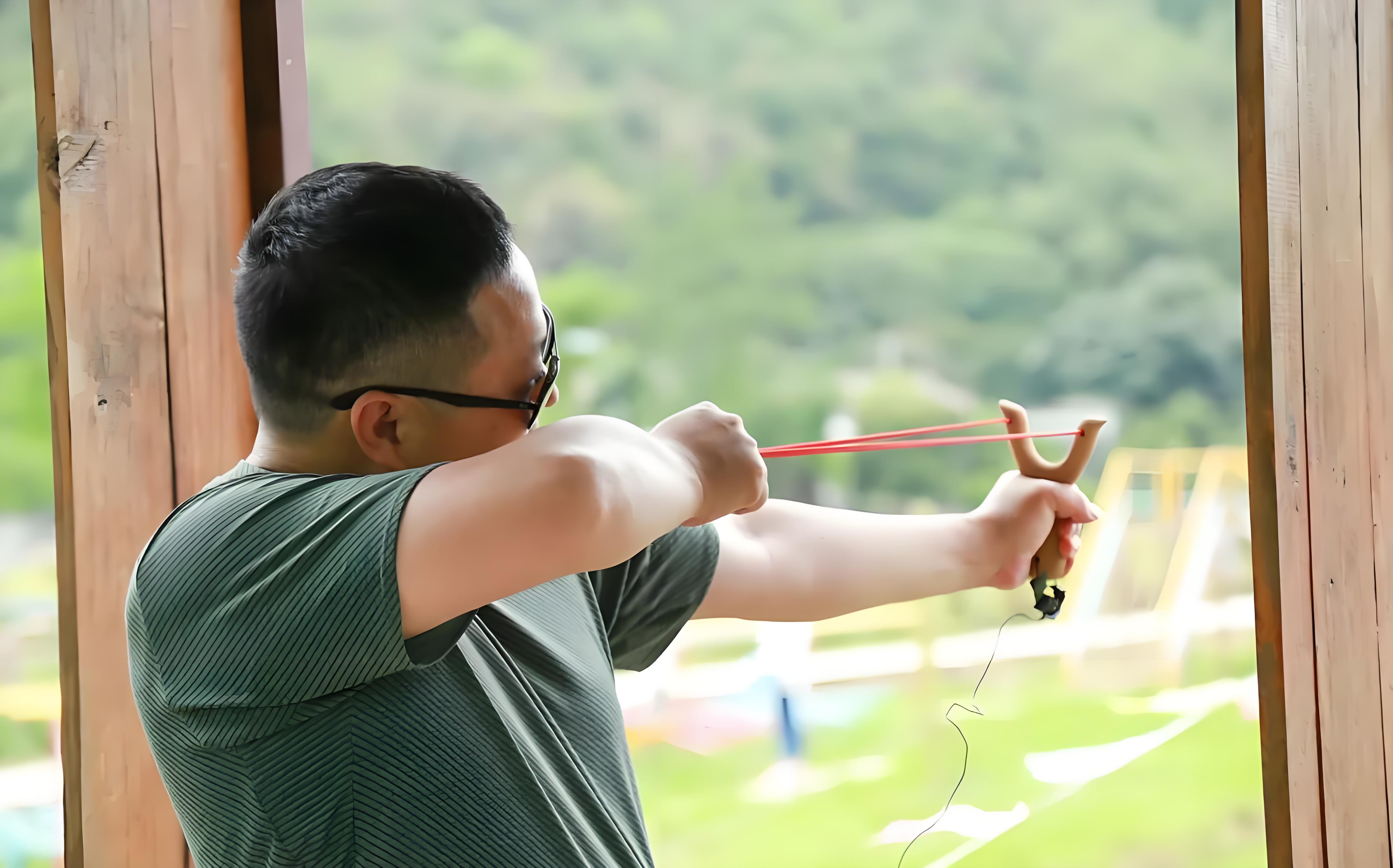
Error Correction: A common mistake among beginners is to "throw your arms" for increased power, which can cause the bullet's trajectory to deviate. The correct approach is to keep your gripping hand close to your cheekbone, and apply force evenly with your drawing hand, using your back and shoulder muscles to drive the shot, rather than simply swinging your wrist.
Test Pulls to Get a Good Feel: Before each actual shot, pull the rubber band three times to feel the peak tension and ensure consistent draw length each time (a 1 cm deviation in draw length can result in a 10 cm difference in landing point at 30 meters).
3. Review: Use "Data Recording" Instead of "Blind Practice"
Prepare a notebook or mobile phone memo to record key data from each training session:
Date, weather (wind speed, light), equipment used (slingshot model, rubber band taper);
The impact distribution of 10 bullets (marked with a simple target paper);
Problems encountered that day (e.g., "shaky bow grip" or "misjudgment of windage") and how to correct them.
Keep recording for a week and you'll clearly identify your weaknesses, allowing you to improve them and double your efficiency.
四、 Expanding Fun: Turning Challenges into "Social Games"
The joy of slingshot shooting isn't limited to solo practice. Turning the 30-meter challenge into a community activity can bring a greater sense of accomplishment:
Family and Child Challenge: Safe and Bonding
Kids' Edition Rules: Reduce the distance to 10 meters, use soft clay balls and a plastic slingshot, and replace the target with a colorful foam board (to prevent injury). Parents and children compete to see who can get their bullet closest to the bull's eye. This not only cultivates children's concentration but also promotes safe bow use.
Creative Rewards: The winner will receive the title of "Family Slingshot Coach" and be responsible for setting up the next shooting range, increasing participation.
Community Online PK: Share your results and win a "Badge of Honor"
Launch a "30-meter Challenge Weekly Competition" in the slingshot community. Players upload shooting videos (including the target and impact point) and are ranked based on accuracy. The top three will receive a virtual badge of honor or a small gift (such as a custom target paper or rubber band maintenance kit). Newcomers can start a "Progression Challenge": record your progress from "2 out of 10" to "8 out of 10," share your training experiences, and cheer on community members for a heartwarming atmosphere.
Outdoor Camping Connection: Integrate Challenges into Leisure Time
Bring a lightweight slingshot and target equipment to a safe, open campsite, set up a "30-meter Challenge Zone." Practice shooting during the day, and gather together to share tips at night. You can even play "Slingshot Truth or Dare"—those who miss a target have to share a "childhood story about slingshots" to make outdoor time even more fun.
五、Safety First: These "Red Lines" Must Not Be Crossed
Slingshot Challenges must be conducted safely and legally, especially at a longer range of 30 meters. Remember these rules:
Site Selection: Stay away from residential areas, schools, and high-voltage power lines. Ensure there is a "safety buffer zone" (such as dense trees or earth walls) behind the shooting range to prevent bullets from accidentally hitting people or property.
Prohibited Targets: Shooting animals, glass, or flammable or explosive objects is strictly prohibited. Soft targets such as foam, cardboard, and sand are preferred to reduce the risk of ricocheting bullets.
Protective Gear: Regardless of your skill level, goggles must be worn at all times. Beginners are advised to wear long-sleeved clothing to prevent rubber bands from rebounding and hitting their arms.
Minor Supervision: Players under 16 must be accompanied by an adult and use a child-safe slingshot (with low draw weight and soft marbles).
The appeal of the 30-meter precision shooting challenge lies in the joy of improving your skills through repeated aiming, firing, and adjustments, while also allowing you to connect with like-minded individuals through community interaction. Don't worry if you're a beginner. Start with 10 meters and improve by one meter per week. Before you know it, you'll find that the 30-meter bullseye that once seemed unattainable is now within your reach.
Get started now: find a safe area, set up your target, and record the impact of your first bullet—this will be the beginning of your "Path to Sharpshooting." Share your challenge results or unique range designs in the comments section. Let's unlock more fun with slingshots together!